AMD: Advancing AI Data Centres, Networks and Robots
AMD CEO Dr Lisa Su and her leadership team announced a series of hardware and software developments at the company's Advancing Artificial Intelligence event, designed to drive the next wave of data centre infrastructure, enterprise computing and physical AI applications.
The portfolio spans both hardware and software innovations – ranging from the sixth-generation EPYC CPUs and Instinct MI400 GPUs through to the newly launched ROCm.ai developer suite – representing a major milestone in AMD's commitment to an open ecosystem approach.
During the Advancing AI keynote opening, Lisa stated: "Our mission is to push the boundaries of high performance and AI computing. I often say AI is the most important technology in the last 50 years."
Lisa highlighted that the industry now processes more than 35 quadrillion tokens monthly, with inference workloads accounting for 60% of current capacity rather than training operations.
She attributed this shift to the rise of agentic AI: "Compute demand is growing at an incredible pace. When you ask the agent to do something, it has dozens of steps… so you need lots of GPUs to do all that reason and a lot of CPUs to orchestrate every step around it."
ROCm.ai developer platform launched
AMD's newly introduced ROCm.ai – an AI-native developer platform – aims to simplify AI development workflows across AMD infrastructure from initial concept through to production deployment.
The platform consolidates deployment, optimisation and AI-assisted capabilities through three primary components:
- ROCm CLI: A command-line interface that simplifies installation, validation, serving and workload management processes
- AMD Skills: AMD-developed expertise embedded within widely used AI coding assistants including Claude, Cursor and Codex
- Hyperloom: An open-source agentic framework designed to automate comprehensive inference optimisation
These integrated tools provide a cohesive workflow enabling developers to install, deploy and resolve AI workload issues more efficiently on AMD infrastructure. According to AMD, ROCm.ai could deliver performance improvements including up to 3.3x faster inference and 2.4x faster training on average.
Anush Elangovan, Corporate Vice President of AI Software at AMD, says: "AMD is committed to helping developers move faster than ever. ROCm.ai brings agentic AI development to AMD platforms – agents that don't just answer questions, but profile, debug and drive workloads toward peak performance on AMD hardware."
- Inference: Up to 3.3x faster on average
- Training: Up to 2.4x faster on average
Helios rackscale solution unveiled
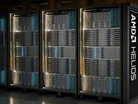
AMD has also unveiled its Helios rack-scale platform at Advancing AI.
This open infrastructure solution is built for foundation model training and frontier AI deployment, combining sixth-generation EPYC CPUs, Instinct MI455X GPUs, Pensando networking and ROCm software within a unified architecture.
Engineered for operational efficiency, AMD reports Helios could offer 50% greater high-bandwidth memory capacity and up to 30% more tokens per dollar compared to alternative systems.
The EPYC 9006 Series
The sixth generation of AMD’s EPYC Service CPUs delivers solutions for agentic AI, enterprise and high-performance computing (HPC) workloads.
With agentic AI depending on CPU-powered infrastructure to run agents, coordinate work around the model and connect to enterprise data and services, the sixth gen matches the right CPU to each stage of the agentic workflow to improve throughput, utilisation and efficiency across the data centre.
The series – including EPYC 9006 SP7, EPYC 9006 SP8, 9006X SP7 and 9006 LP – are built to match the right processor to the right job.
“As agentic AI reshapes how enterprise infrastructure is designed and deployed, EPYC is evolving with our customers once again,” says Dan McNamara, Senior Vice President and General Manager of Compute and Enterprise AI at AMD.
“6th Gen AMD EPYC delivers workload-optimised compute for the full spectrum of modern data centre needs; from running more agents and feeding GPUs across rack-scale AI infrastructure to powering the business-critical applications and services organisations rely on every day.”
Instinct MI400 GPU series
The Instinct MI400 Series GPUs are engineered to address large-scale frontier AI and HPC computing demands.
The product line includes the MI455X, optimised for hyperscale AI infrastructure and frontier training utilising advanced HBM4 memory technology, alongside the MI430X, developed specifically for sovereign AI applications and scientific computing workloads.
Vamsi Boppana, Senior Vice President of AI at AMD, says: "The AMD Instinct MI400 Series extends our AI portfolio with purpose-built solutions optimised for the full spectrum of AI and HPC deployments, built on an open software foundation that gives customers the flexibility to innovate at every scale."
Through the combination of advanced compute capabilities, enhanced security features and adaptable system architecture, the MI400 series could provide the high-performance infrastructure required to scale demanding workloads with reliability.
The industry consuming more than 35 quadrillion tokens every month
AMD Robotics Partner Network and physical AI
AMD has launched its Robotics Partner Network, assembling hardware and software partners with the objective of accelerating robotics and physical AI system development and deployment on AMD platforms.
The programme welcomes original design manufacturers, independent software vendors, simulation providers, sensor and perception companies, safety and benchmarking partners and system integrators.
Amey Deosthali, Senior Director of Industrial, Robotics and Healthcare at AMD, explains: "No single company will build the future of physical AI.
"Building robots requires bringing together AI models, middleware, sensors, simulation tools, system integrators and production hardware. Too often, those pieces come from disconnected vendors with little validation between them."
"With the AMD Robotics Partner Network, we are extending the AMD open ecosystem approach into robotics to help reduce integration efforts, shorten development cycles and allow roboticists to move from reference platform to production systems with greater flexibility, portability and confidence."

Ryzen AI Embedded processors
The newly-announced Ryzen AI Embedded X100 Series is a system-on-chip developed for physical AI applications including robotics, smart manufacturing and healthcare systems.
The processor integrates up to 16 Zen 5 CPU cores, an integrated GPU and a dedicated Neural Processing Unit into a single package.
Through a unified memory architecture, these processors could reduce latency and enhance real-time control capabilities, enabling autonomous systems – such as surgical robots or humanoid machines – to perceive, process and respond within physical environments whilst operating under constrained power, thermal and space parameters.
Kirk Saban, Corporate Vice President of Product, Software and Solutions at AMD, says: "The Ryzen AI Embedded X100 Series marks an exciting new chapter for physical AI, unlocking opportunities across a broad range of intelligent, real-time embedded applications."
Additionally, the new Kria AI Solutions – a turnkey platform powered by the Ryzen AI Embedded X100 Series – supports developers in rapidly building and deploying physical AI and autonomous robotics applications.
Kria effectively connects a robot's physical components with its computational intelligence, facilitating real-time sensing, reasoning and decision-making through an open, low-latency framework.
Partnering with Schneider Electric
As senior executives announced software and hardware at the AMD's AI event, AMD announced its partnership with Schneider Electric on Helios AI Reference Design.
As a modular infrastructure component, Helios enables data centres to expand seamlessly from single racks through to gigawatt-scale AI clusters.
Many data centre operators building out AI infrastructure face a persistent problem: matching compute ambition with power and cooling capacity that can actually support it.
Schneider Electric and AMD moved to close that gap, unveiling a jointly engineered reference design for the AMD Helios rack-scale solution.
"Schneider Electric is proud to be AMD’s partner of choice for its first Helios reference design," adds Rob Bunger, Global Director of Data Center Solution Architecture at Schneider Electric.
Company portals



Executives
Amey Deosthali
Sr. Director, Embedded Product Marketing
Anush E.
Vice President - AI Software
Dan McNamara
Senior Vice President & General Manager, Compute & Enterprise AI
Kirk Saban
Corporate Vice President - AECG Product, Software & Solutions
Lisa Su
Chair & CEO
Vamsi Boppana
Senior Vice President, AI