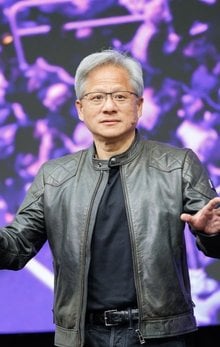
Why NVIDIA CEO Jensen Huang Believes AGI has Arrived

Has artificial general intelligence (AGI) officially arrived? According to NVIDIA CEO Jensen Huang, the answer, essentially, is yes.
Jensen told the Lex Fridman Podcast that NVIDIA, which generated generated US$215.94bn in total revenue in FY2026, has already built systems that meet his definition of AGI.
His assertion comes despite many still treating AGI as a long-horizon milestone. OpenAI CEO Sam Altman has said it remains “thousands of days away,” making Jensen's stance all the more notable.
Jensen frames AGI in operational terms: a capability stack that can materially accelerate the launch and management of technology brands and products, with deployment gated by demonstrable returns that justify investment at scale.
When Lex posited a five‑to‑20‑year window for AGI, Huang replied: “I think it’s now. I think we’ve achieved AGI.”
Jensen went on to pose a hypothetical scenario in which an autonomous, modern AI system independently builds and launches a digital product. In his example, the system could “create a web service, some interesting little app that all of a sudden a few billion people used for 50 cents, and then it went out of business again shortly after".
Impact on the workplace
So, how will AGI impact the workplace? AI and AGI are estimated to automate tasks equivalent to 300 million full-time jobs globally, according to research from Goldman Sachs.
Research from the International Journal of Innovations in Science, Engineering, and Management (IJISEM) also signals a structural shift.
Its report states: "The emergence of AGI presents unprecedented challenges for global labour markets. While narrow AI [Gen AI] already transforms specific sectors, AGI’s human-level adaptability threatens to disrupt all knowledge workers.”
AGI’s entry into the enterprise is, therefore, not "merely an incremental technological step," but a "paradigm shift" with the potential to "revolutionise business, healthcare, and education".
Amir Banifatemi, Chief Responsible AI Officer at Cognizant, believes AGI will pose immediate challenges that warrant near-term action rather than treatment as a distant theoretical concern.
He says: "AGI has become one of the most talked-about topics in technology circles, evoking excitement, speculation and concern.
"Yet, for leaders navigating today’s evolving AI and digital landscape, the more relevant questions are not about when AGI might arrive, but what it means, why it matters and how to prepare."
Explaining AGI
AGI is a hypothetical type of intelligence that, if realised, could learn to accomplish any intellectual task that human beings or animals can perform.
IJISEM, meanwhile, defines AGI as "AI systems capable of performing any intellectual task that a human can". Unlike narrow AI, AGI promises broad adaptability and autonomy, potentially revolutionising work, society and the economy.

While the technology is not expected to be fully developed for "several years", tech giants like NVIDIA have been nearing success.
This being said, studies have shown that humans generally don’t want an AI that is smarter than the average person.
So, with many employees still getting to grips with AI’s integration into the workplace, how will AGI’s adoption be welcomed?



Executives

Amir Banifatemi
Chief Responsible AI Officer
Jensen Huang
Founder and CEO

Sam Altman