
The US Summit: How AI is Transforming Operations
Procurement and supply chain leaders are turning to AI as geopolitical instability creates continuous disruption across global logistics networks.
The technology offers organisations a way to respond to mounting operational demands in an environment where reactive strategies no longer provide adequate protection.
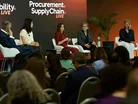
Experts discussed the implementation of AI tools at Procurement and Supply Chain LIVE: The US Summit, where a fascinating debate examined how innovation in AI has affected operations and what future applications could emerge.

Predicting disruption patterns
Global instability has redefined how supply chains operate. At the start of the current period of turbulence, supply chains operated in a constant state of reaction and could not build resilience to withstand hits to stability.
AI has become a core tool for helping global supply chains withstand this pressure. The integration of AI within procurement and supply chain functions focuses less on reaction and more on predicting and mitigating disruption.
Global demand is increasing as supply chains become more complex. Procurement and supply chain leaders have become central to ensuring stability but face immense pressure to deliver results with reduced funding.
Rising inflation and tariff pressures have increased global costs. AI has entered the market as a means to allow these leaders to do more with less, handling time-consuming manual tasks at a fraction of the speed and resources whilst allowing human teams to make decisions and focus on the customer.
Environmental impact of data centres
The global adoption of AI as a tool has created both support and scepticism. The speed at which organisations have adopted the technology has created environmental concerns as data centres operate at greater capacity than ever, consuming large amounts of water, energy and coal.
At The US Summit, experts argued that AI does not consume more resources than manual processes but rather uses them over a shorter period of time. Panellists argued that the resources would be used anyway.
Dr Alyson Freeman, Director of Data Center Sustainability at Dell Technologies, says: "They're using more coal, but they're also using more wind and more solar for all of these data centres.
"Where we are in trying to make this AI transition is we need every bit of energy available. We need to be looking at how do we do carbon capture as a short-term solution? How do we get to the longer term truly sustainable energy choices? In the long run, I believe there are definitely ways that we will move AI to being compatible with our lives and our planet and sustainability. And AI can actually be part of this solution."
Addressing workforce transformation
The implementation of AI has raised concerns about how the technology affects the workforce. The technology is seen as a double-edged sword, particularly when addressing labour gaps, as many industries face workforce shortages and skills gaps.
The introduction of AI is filling these gaps and ensuring the supply chain can continue to operate. Sceptics are concerned that this could lead to AI taking over the workforce, as the technology can operate for longer, without breaks and more efficiently than human workers.
Panellists at the debate addressed this issue and argued that AI aids with each job rather than taking it over completely.
Luhua Xu, AI Product Marketing Lead at Zip, says: "I think AI will not replace our job entirely anytime soon. When we're seeing agents that we're deploying today, it helps you do your job better and in a more productive way.
"Ideally, you'll still need human oversight at the end, and that just cannot be replaced by AI today. It's helping you to transform your four hours of work to maybe two to three hours. And then you can also spend time doing the more strategic work at the end. So that's what I see in the short term. In the long term, I think that's the scepticism that comes with every new technology and every new product. There will always be questions around, will we lay off people with industrial revolution or with AI?"
"It's the same question. But then hopefully as human beings in general, we get to the future that we do less manual work in general and we can spend time on more meaningful things."
Dr Jutta Pils, Global Head, Digital & Agentic Innovation & Sustainability Strategy at DuPont, added: "My only advice is, AI is not taking your job."
"Even if you're an administrative person, it's not taking your job. AI would contribute to your job, but you have to learn it in your area. If you're administrative assistant, learn the tools to manage more people in your company, learn the tools to have more workflows in your company, make your human knowledge relevant and use AI to emphasise and grow."
"So it doesn't necessarily need to get rid of people, but naturally it's leadership and also your own drive."
Job creation potential
In fact, the panellists argued that AI could create more jobs and that implementation needs to maintain a human-in-the-loop approach. The tech can be applied to manual and repetitive tasks to cut down the time spent on each task, allowing leaders to make decisions faster and with greater accuracy.
By utilising AI in this way, businesses waste less time on behind-the-scenes work to enable stronger customer-focused interaction and to build confidence in decision making for leaders.
Rasha Hasaneen, Chief Innovation & Growth Officer at Vontier, says: "How much of [the fear is] similar to the dotcom bubble where what you're seeing is AI is coming in and businesses that maybe weren't adding as much value are suffering? In the industrial space, we've got a while. Vontier is critical infrastructure in almost every country we operate in.
"There's not going to be a situation where you don't have a human in the loop when you're talking about the energy infrastructure of a country or the retail infrastructure of a country.
"Our customers were the ones that had to be open during COVID. And so in those situations, we're going to be slower to adopt AI in mission critical operations, faster to adopt AI, to reduce non-value-added work.
"We're going to have a pretty good runway where we still have humans in the loop. We still need that expertise, that decision making, that accountability to ensure that the critical infrastructure remains intact. Maybe over time, there will be less of a need for as many people doing a specific job, but it doesn't mean that there aren't additional jobs that would be created."
Ultimately, the debate focused on addressing concerns that people in the industry may have for the environment and their job security. It also addressed that AI is likely to remain part of operations and when implemented properly can work closely with a human workforce to ensure efficiency and productivity.
Company portals





Executives
Alyson Freeman
Director, Data Center Sustainability
Jutta Pils
Global Head, Digital Sustainability & ESG Technology Strategy
Luhua Xu
Product & GTM
Rasha Hasaneen
Chief Innovation & Growth Officer